
Train Wreck
Co-Op, Base Defense
A Local Co-Op game that can deepen the bond with you and your friends
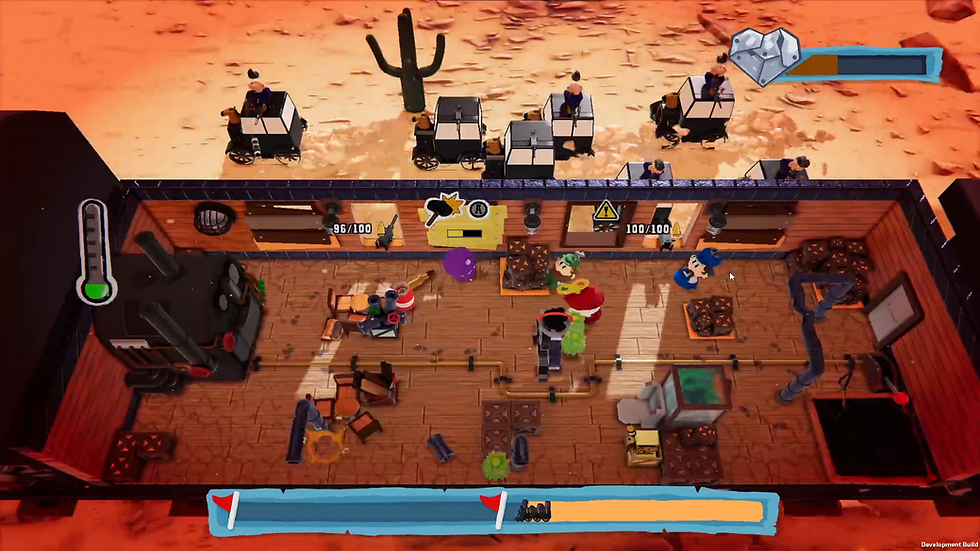
Train Wreck is a 3D, Top Down, Co-Op Base Defense game. Where you and 3 others take control of Train Operators, who will have to Repair, Defend, and Maintain your train, in order to reach the Destinations.
Level 1
The Level Design Process
Level 2


Level 3

Level 4

These are the final levels that are in the game with art. This is the game's final product that you can access in the VFS arcade.
Figure 1
The Level Design for Train Wreck was a fairly challenging and fun process to think about.
I had to figure out what the level would look like in my head. So I just drew it out and tried to imagine the type of movement flow the game would realistically look like

This is how I first thought the level would originally look like in my mind, just a rectangle split into 3.
With something vague in my head I started to plan out placements of the elements for our Core Loop and Main mechanics such as the Firebox, Windows, Pipes, Resource Stations, and Coal stations.
This led to me to create a very basic level of elements with these rules:
1. Furnace has to be on the left side
2. Each Level should have a different amount on windows
3. The middle section has to be the busiest areas in each level
4. It's ok for players to run into each other.
Figure 2A
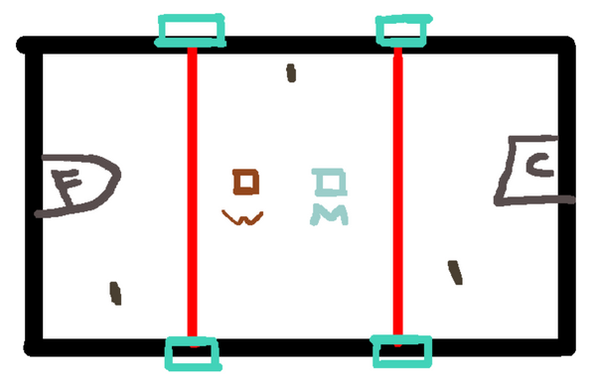
After looking at the original idea Figure 2A is what I thought a very high-level 2D layout and started to think of ideas as to how I can guide players around the level
Figure 2B

This is what the pathing would look like for the original Design where the players would be getting attack from both sides. Design in the final product is only on the top side of the train.
Seeing everything be a direct line towards a lot of objectives, to elevate a lot of the mechanics and systems I defined everything into different classes being, Dynamic Obstructions, and Static Obstructions.
- Dynamic Obstructions are anything that blocks the player that can either, move, spawn in, or be placed anywhere on the floor. Examples would be, other players, fire, enemy bullets, or any Wood planks and Metal pipes placed on the floor.
- Static Obstructions are anything that blocks the player that will always stay where they are, these are your Boxes, Pipes, Levers, and objects in the final product like the Cogs, Plants, Tables, and Chairs.
Figure 3

This is the first Level and first iteration of the level in Train Wreck. The Red circle indicates what would be a Dynamic obstruction, the green are examples of obstructions that would be static.
I initially chose a 21x8 layout for our prototype and created several 2D designs. We later changed it because the play and screen space felt too small and cramped. Still, I’m proud of these layouts—they demonstrated our mechanics well, even if they limited player options.
I think the movement flow I wanted from the game still did show up in these games (Figure 4B). I am proud of the amount of options I was able to give to the player with these constraints.
Figure 4C

I created this 2D layout in Milestone 2 because the team at the time was deciding to revert the level to its original size.
Figure 4B

The movement flow in Level 2 Iteration 2 worked well for what I initially envisioned before the metric change.
Figure 4A

Amount of levels (in rows) the game originally had with the iterations that were made overtime (in Columns). Just a look at all 8 I originally had.
After the prototype, we increased the train size to 33x12 for better screen and play space. This change was a success—it created more engaging movement, chokepoints, and greatly enhanced the Dash mechanic, leading to some of the game's best moments.
Figure 5

The new 2D Layout with iterations. Both Level 2 iterations ended up not being used.
I also had to choose to cut out some levels as I decided to switch levels out because I either:
1. Didn't like how it played out
2. Dead space
3. Difficulty
4. I pivoted to enhance more cooperation
We will use a Old Levels 2D layout that made it to the game as a example (Figure 6)
Figure 6C

However since the Coal Pile is in the middle of the train, and since we have a hop mechanic that let's us jump over obstructions the movement flow looked more like the Red line
Figure 6A

This was what Level 2 used to be at some point into production, however was replaced due to previous reasons
Figure 6D

Because of these problems with the design a whole 3rd of the train was ignored, which I personally felt like it was a bad idea to let this idea reach further then Milestone 1
Figure 6B

Here is what the movement flow would look like on paper, this is something I wanted to at least test and watch players play.
Here are the levels that made the final cut, these levels have shown through the production process as the best ones to go with. All of these levels showed progression in difficulty, really good movement flow, pacing, and learning and teach the player a lot of the base mechanics. (Figure 7 is level 1, Figure 8 Level 2, Figure 9 Level 3, Figure 10 Level 4)
Figure 7A (Lvl1)

This is the first level to the game, I decided to want to introduce mechanics at a slower rate so this level doesn't have a gun or any points to hop and throw through. The level is designed to be a tutorial of how to play the game in the least stressful environment in the game.
Figure 8A (Lvl2)

In the second level I wanted to introduce the gun. This addition I kept the elements in roughly the same place.
Figure 9A (Lvl3)

In the third level, I emphasized tighter paths and more obstacles to encourage the player to utilize the hop mechanic. This level has two guns, which can mislead new players into thinking both should be used. However, managing the train with two gunners proved harder, prompting players to learn when to hop off and assist teammates through better communication.
Figure 10A (Lvl 4)
This level improves the throw mechanic by splitting the train 33%:66%. The smaller 33% holds all repair materials, while the larger 66% contains what needs repairing. Essential items like the lever, ammo, and coal are on the 66% side, requiring the 33% side to throw them across to progress.
Figure 7B (Lvl1)

General consensus of how movement usually went when they were trying to get from East to West of the train, wider spaces allow players to have enough space to go around even when there are 4 players
Figure 8B (Lvl2)

Movement flow gets a lot more interesting with choke points being a 3-2-3 set up with around the same width of pathways as lvl 1.
Figure 9B (Lvl3)

Tighter movement flow and increased player overlap create social tension that enhances gameplay. To amplify this, I relocated key elements to encourage movement across different sections of the level.
Figure 10B (Lvl 4)

At the split marked by the green rectangle, players can throw items more efficiently than navigating the chokepoint. Fueling the train also requires one player to pull a lever for another, boosting communication. With resources like wood and metal on the opposite side, throwing becomes essential for optimization and level completion.
The process of my design for this game was very fast and coordinated as I knew a lot of the systems and how they worked together in order to create these products, of course iterations and multiple versions came and went. These levels exemplified the systems and mechanics of our game to the fullest while including a very quick drop in and play session with friends and family.
The Systems & Game Design Process
Train Wreck in terms of it's design has never changed. The aim was to make a game where the player feels like they are always on their feet.
We had interconnecting mechanics where the game is being influenced as a whole, these mechanics were very big for the overall feel of the game that was influencing not just the game design, as well as the visual feedback, tech design, and audio feedback.
Figure 1
Player Character
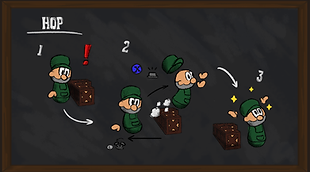
The player character was easy to design due to similarities with reference games like Overcooked and Moving Out, which share core movement mechanics such as walking and dashing, however the dashing mechanic we decided to change it to a hop mechanic where players would hop over obstructions. Additional player actions include picking up, interacting, throwing, and a unique mechanic shooting. This shooting element sets our game apart by introducing enemy conflict, adding urgency and a sense of purpose for the player.
Figure 2




Tutorialization
I was involved in deciding how to tutorialize the game. I initially pushed for a full tutorial level like Moving Out to introduce mechanics upfront, but the team preferred a more organic approach.
As a compromise, I looked to Overcooked for inspiration but felt its style didn’t suit us due to our limited number of unique mechanics. Instead, I focused on introducing one key mechanic per early level:
-
Level 1: Moving the train
-
Level 2: Shooting and reloading
-
Level 3: Hopping (emphasized through level design with many obstructions)
-
Level 4: Throwing (As there was a lot of small blockage)
While this approach worked, some mechanics—like repairing—weren’t tutorialized directly. We addressed this by adding UI prompts in Level 1 for repairing windows and pipes.

Co-Op
I strongly advocated for making the game co-op, as I believed a single-player version would feel overwhelming and turn into a chore. While there were concerns about scope, I felt co-op would reduce emotional friction and enhance the experience.
Adding a social element also shifts frustration away from self-blame, allowing players to share the challenge—and the fun. Cooperative play opens up more engaging and entertaining possibilities overall.
Figure 3


Visual Feedback
I personally think our biggest challenge was our visual feedback/clarity as we had a lot of struggles in communicating to the player what is going on in the screen.
We had to do a lot of iteration through it involving both VFX and UI, we all tried to pitch in ideas as a team, however I think that we learned a lot of how to tell the player what is going on and how things work.